CHITRALI
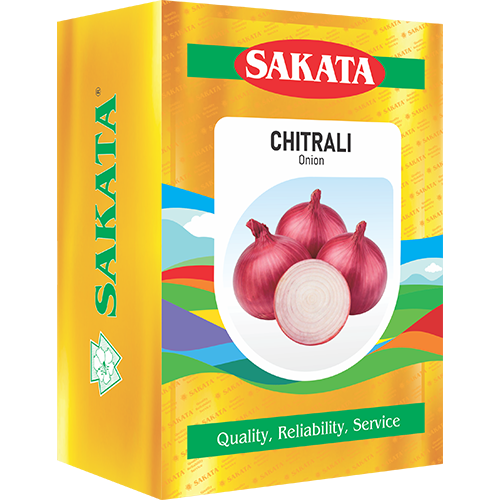
| Crop Name | Onion |
|---|---|
| Hybrid Name | Chitrali |
| Segment | Kharif |
| Maturity Period | Direct sowing: 100 -110 days, Transplanting: 90-100 days |
| Characteristics |
• Red Color globe shape bulbs • Uniform bulb shape and Size • Average bulb weight 90-100 gms |
| Average yield | 15-20 t / ha |
| Climate | The optimum temperature range for its growth is 20-25 °C |
| Sowing Window | Kharif: April- July |
| Focused Market | All states |
| Parameter | Description | ||||||||||||||||||||||||||
|---|---|---|---|---|---|---|---|---|---|---|---|---|---|---|---|---|---|---|---|---|---|---|---|---|---|---|---|
| Scientific Name | Allium cepa | ||||||||||||||||||||||||||
| Hybrid | Chitrali | ||||||||||||||||||||||||||
| Soil | Red loam to black soils with good drainage facilities is highly suited for onion cultivation. It performs well at a soil pH range of 6-7 and a mild season without extremes of heat and cold. | ||||||||||||||||||||||||||
| Land Preparation | Plough the land to a fine tilth and form ridges and furrows at 45 cm spacing. Sow the bulbs on both the sides of the ridges at 10 cm apart. | ||||||||||||||||||||||||||
| Spacing | 15 cm X 10 cm | ||||||||||||||||||||||||||
| Climate | Onion is a cool season vegetable and grows well under mild climate without extreme heat or cold or excessive rainfall. The ideal temperature for vegetative growth is 12.8 – 23.0 °C. For bulb formation it requires long days and still higher temperature (20-25 °C). | ||||||||||||||||||||||||||
| Season | Rainy Season | ||||||||||||||||||||||||||
| Fertilizers & Manures |
|
||||||||||||||||||||||||||
| Irrigation | Irrigate at the time of planting of seedlings and third day and later at weekly intervals. Withhold irrigation 10 days before harvest. | ||||||||||||||||||||||||||
| Weed Control | Pre-plant incorporation of Basalin (2 kg a.i./ha) along with one hand weeding at 45 days after transplanting | ||||||||||||||||||||||||||
| Any Special Crop Practices | No | ||||||||||||||||||||||||||
| Diseases |
|
||||||||||||||||||||||||||
| Pests |
|
||||||||||||||||||||||||||
| Harvest | Harvesting is done by pulling out plants when tops are drooping but still green. Maturity: Direct sowing: 100-110 days and Transplanting : 90 - 100 days after planting |
||||||||||||||||||||||||||
| Yield | 15-20 t/ha | ||||||||||||||||||||||||||
| Disorder / Symptom | Description & Control |
|---|---|
| Curing | The bulbs should be adequately cured for proper development of skin colour and to remove field heat before storage of bulbs. It is done till the neck is tight and outer scales are dried. This will prevent infection of diseases and minimize shrinkage loss. Bulbs are cured either in field or in open shade or by artificial means before storage. During kharif season, bulbs are cured for 2-3 weeks along with top. In rabi, bulbs are cured in field for 3-5 days, tops are cut leaving 2.0-2.5 cm above bulb and again cured for 7-10 days to remove field heat. |
| Storage | After curing, bulbs are stored in well ventilated rooms by spreading them on dry and damp proof floorings or on racks. Periodical turning of bulbs and removal of rotten and sprouted bulbs is highly essential. |
| Grading | These necked, bolted and decayed bulbs are removed. Cured bulbs are graded based on size, and depending on market to which it is sent. |
| Physiological Disorder | |
| Bolting | Emergence of seed stock prior to time of bulb formation and adversely effect the formation and development of bulbs. It is due to exposure to low temperature Control:
|
| Sprouting | It is associated with excessive moisture at maturity and supply of nitrogen Control:
|
| Splitting and Doubling of Bulbs | Adverse climatic conditions and imbalanced nutrient supply leads to splitting and doubling of bulbs. Mechanical injury to plant during hoeing and weeding initiates new growth and causes splitting and doubling of bulbs |