| Parameter | Description | ||||||||||||||||
|---|---|---|---|---|---|---|---|---|---|---|---|---|---|---|---|---|---|
| Scientific Name | Brassica oleracea var. capitata | ||||||||||||||||
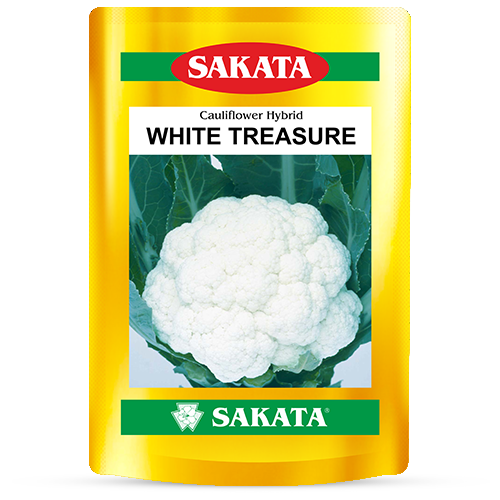
| Hybrid | F1 White Treasure | ||||||||||||||||
| Soil | For early crop light soils are best whereas for late crop heavy soils are preferred. The optimum soil pH is 6 to 7. | ||||||||||||||||
| Land Preparation | Ploughing of land 2-3 times and make fine tilth | ||||||||||||||||
| Spacing | 60 × 45 cm or 45 × 30 cm | ||||||||||||||||
| Climate | Cauliflower thrives under a cool, moist climate, particularly during the winter months in the plains. The ideal temperature range for Cauliflower growth is between 15°C and 25°C. | ||||||||||||||||
| Season | Tropical: Mid Feb – March | ||||||||||||||||
| Seed Rate | 0.2 Kg/ha | ||||||||||||||||
| Fertilizers & Manures |
|
||||||||||||||||
| Irrigation | 3-4 days interval to maintain field capacity in winter and 7 days once in rainy season | ||||||||||||||||
| Weed Control | Manual weeding: 2-3 times | ||||||||||||||||
| Any Special Crop Practices | |||||||||||||||||
| Diseases |
|
||||||||||||||||
| Pests |
|
||||||||||||||||
| Harvesting | Harvesting was ready by 55-60 DAT | ||||||||||||||||
| Yield | 15-20 t/ha | ||||||||||||||||
F1 White Treasure
| Crop Name | Cauliflower |
|---|---|
| Hybrid Name | F1 White Treasure |
| Segment | Tropical |
| Plant Habit | Erect plant habit |
| Maturity Period | 55–60 DAT |
| Characteristics | • Early maturity hybrid with good plant vigor • White, compact and semi dome-shaped curd • Good heat and rain tolerance |
| Average Curd Weight | 600–800 g |
| Climate | The ideal temperature range for Cauliflower growth is between 15°C and 25°C. |
| Sowing Window | Mid Feb–March |
| Focused Market | North, East, West and Central India |
| Parameter | Description |
|---|---|
| Riceyness | It manifests in the elongation on peduncle wearing flower buds, rendering curds granular, loose and somewhat velvety. A premature initiation of floral bud is characterized by riceyness in cauliflower and is considered to be of poor quality for marketing. It can be controlled by cultivation of appropriate varieties and following proper season with recommended cultural practices. |
| Fuzziness | It appears as the flower pedicels of velvety curds elongate. The anomaly is both hereditary and non-hereditary. Cultivation of cauliflower, out of their normal season encourages fuzziness. Sowing good quality seed in right season under proper cultural practices, minimizes fuzziness. |
| Leafiness / Bracting | This disorder is commonly seen by formation of small thin leaves from the curd which reduces quality of curd. Extremely small green leaves appear in between the curd segment due to inheritable or non-heritable factors. Prevalence of high temperatures during curding phase aggravates leafiness. Certain varieties are more sensitive to leafiness or bracketing than other. It can be controlled by selection of varieties according to their adaptability. |
| Browning (Brown Rot or Red Rot) | It is caused by boron deficiency which is influenced by soil pH. The availability of boron decreases at neutral soil reaction. It is characterized by sign on the young leaves that become dark green and brittle. The old leaves puckered, chlorotic and often drops off. This may be controlled by application of borax or sodium borate or sodium tetra borate at the rate of 20 kg/ha a soil application. In case of acute deficiency, spray of 0.25 to 0.50 per cent solution of borax at the rate of 1 to 2 kg/ha depending upon growth, soil reaction and extent of deficiency. |
| Whiptail | Deficiency of molybdenum causes ‘whiptail’ syndrome, especially, in highly acidic soils. Because high manganese concentrations in such soils hinder the uptake of molybdenum which seldom occurs when the soil pH is 5.5 or higher. The young cauliflower plants become chlorotic and may turn white, particularly along the leaf margins. They also become cupped and wither. and extent of deficiency. In older plant, the lamina of the newly formed leaves are irregular in shape, frequently, consisting of only a large bare midribs and hence, the common name “whiptail”. It can be corrected by application of lime or dolomite limestone to raise the soil pH up to 6.5 or higher. Sodium or Ammonium molybdate at the rate of 1-2 kg/ha as soil application can also control “whiptail” of cauliflower. |
| Buttoning | Development of small curds with inadequate foliage in cauliflower is known as buttoning. It is also referred to as premature heading. The leaves are so small that cannot cover the formed head. The curds are non marketable and often malformed and lacks color or compactness .It can be be controlled by using quality seedlings and proper cultural management practices. |