| Parameter | Description | ||||||||||||||||
|---|---|---|---|---|---|---|---|---|---|---|---|---|---|---|---|---|---|
| Scientific Name | Momordica charantia L. | ||||||||||||||||
| Hybrid | F1 Amira 308 | ||||||||||||||||
| Soil | Sandy to sandy loam and medium black soils rich in organic matter with pH range of 6.5-7.5 is considered as optimum | ||||||||||||||||
| Land Preparation | The land is ploughed and brought to a fine tilth by 1-2 crosswise ploughing and levelled. Furrows are opened at a distance of 1.5-2.5 m depending on the support system to be adopted. | ||||||||||||||||
| Spacing | 150*60 cm | ||||||||||||||||
| Climate | It is a warm season crop grown adopted to Temperature range of 24-27°C is considered as optimum for the growth of the vines. | ||||||||||||||||
| Season |
Rainy: June-Aug Summer: Feb-April |
||||||||||||||||
| Seed Rate | 1.5 to 2.5 kg/Ha | ||||||||||||||||
| Fertilizers & Manures |
|
||||||||||||||||
| Irrigation | Irrigation is given at weekly intervals to keep the moisture well maintained at the root zone, to promote rapid taproot development. | ||||||||||||||||
| Weed Control | The crop needs 2-3 weeding operations. First weeding 30 days after planting; subsequent weeding at monthly intervals. | ||||||||||||||||
| Any Special Crop Practices |
Bitter gourd being a weak climber needs support for its growth. The plants trailed on the support (bower) continue to give yield for 6-7 months. In bower system, planting is done at a spacing of 2 x 1.5 m. Furrows are opened at 2 m, irrigation channels at 5-6 m. Wooden poles (3 m) pitched at ends of alternate furrows at 5 m, connected with wires forming a network. Seeds dibbled 1 m apart. Initial vines trailed on ropes till reaching bower. New tendrils are then trailed on the bower. |
||||||||||||||||
| Diseases |
|
||||||||||||||||
| Pests |
|
||||||||||||||||
| Harvesting | 1st harvesting starts 60-65 days after transplanting, further pickings should be done at an interval of 2-3 days as bitter gourd fruits mature very fast and turn red. Harvesting should be done in the morning hours and the fruits should be stored in shade after harvesting. | ||||||||||||||||
| Yield | 35-45 t/Ha | ||||||||||||||||
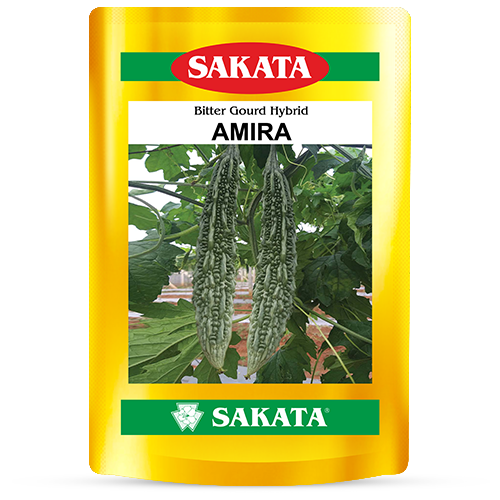
F1 Amira 308
| Crop Name | Bitter Gourd |
|---|---|
| Hybrid Name | F1 Amira 308 |
| Segment | Green Long Spiny |
| Plant Habit | Vigorous vines |
| Maturity Period | 60–65 DAT |
| Characteristics | • Uniform green long fruits with blunt spines • Fruit length: 25–30 cm • High yielding potential suitable for long duration harvest • Good market acceptance • Suitable for long-distance transportation |
| Average Fruit Weight | 200–250 g |
| Climate | Warm season crop adapted to a temperature range of 24°–27°C. |
| Sowing Window | Rainy: June–August, Summer: February–April |
| Focused Market | All India |
No description