| Parameter | Description | ||||||||||||||||||
|---|---|---|---|---|---|---|---|---|---|---|---|---|---|---|---|---|---|---|---|
| Scientific name | Raphanus sativus | ||||||||||||||||||
| Hybrid | F1 Prince 1111 | ||||||||||||||||||
| Soil | Being a root crop, radish requires loose and friable soil, rich in organic matter. | ||||||||||||||||||
| Land Preparation | Ploughing the soils with 2-3 times, make fine tilth with rotavator and apply recommended FYM at time of ploughing. | ||||||||||||||||||
| Spacing | 15*10 cm | ||||||||||||||||||
| Climate | Ideal temperature for growth and development of quality roots in radish is 10-15.5°C. Though it can tolerate high temperature, roots develop pungency under hot weather. | ||||||||||||||||||
| Season | Winter | ||||||||||||||||||
| Seed Rate | 7.5 kg/ha | ||||||||||||||||||
| Fertilizers & Manures |
|
||||||||||||||||||
| Irrigation | Radish requires plenty of water from sowing to harvest. For rapid germination and subsequent production of roots, soil should be moist and loose. So irrigate immediately after sowing. If irrigation is restricted, roots will be tougher and pungent, making it unfit for marketing. | ||||||||||||||||||
| Weed Control | Manual weeding required at 20 DAS | ||||||||||||||||||
| Any special crop practices | |||||||||||||||||||
| Diseases |
|
||||||||||||||||||
| Pests |
|
||||||||||||||||||
| Harvesting | Roots will be ready for harvest in 45-50 days after sowing. Harvesting is done manually. A light irrigation is given before pulling out roots. After harvesting, roots are washed, made into bundles and marketed along with a few leaves. | ||||||||||||||||||
| Yield | 45-50 t/ha | ||||||||||||||||||
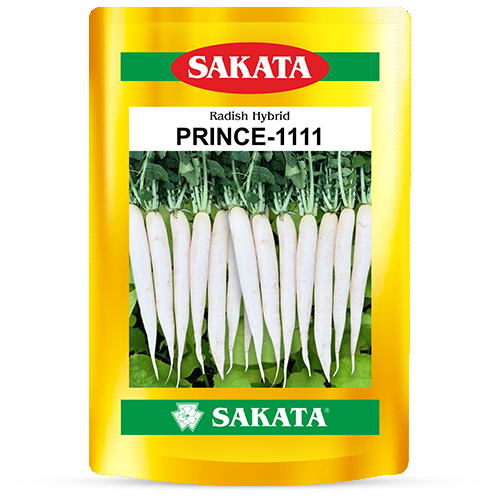
F1 Prince 1111
| Crop Name | Radish |
|---|---|
| Hybrid Name | F1 Prince 1111 |
| Segment | Mino Early |
| Plant Habit | Strong and vigorous plant |
| Maturity Period | 45–50 DAS |
| Characteristics |
• Bright white colour and cylindrical root • Root length: 30 to 35 cm and width 2.8 to 3 cm |
| Average Yield | 45–50 t/ha |
| Climate | Ideal temperature for growth and development of quality roots in radish is 10–15.5°C. |
| Sowing Window | Winter |
| Focused Market | RJ, UP, UK, PB, HR, AS, BHR, HP, J&K, MP, MH, WB |
| Parameter | Description |
|---|---|
| Forking | Radish roots may develop multiple, branching shapes, which can be caused by uneven soil compaction or excessive moisture. Control : Soil should be loose and friable, avoid clods. |
| Pithiness / Sponginess | This disorder manifests as a hollow or spongy texture within the radish root, often due to excessive root growth compared to the plant’s ability to assimilate nutrients. Control : Avoid calcareous soils which inhibit nutrient uptake. |
| Cracking / Splitting | Cracks or splits can occur in the radish root, especially if watering is uneven or if the roots are left in the ground for too long. Control : Irrigation management and timely harvesting. |
| Internal Browning (Brown Heart) | This is characterized by reddish-brown discoloration in the central part of the root and is linked to boron deficiency. Control : Nutrient management. |