sakata Close

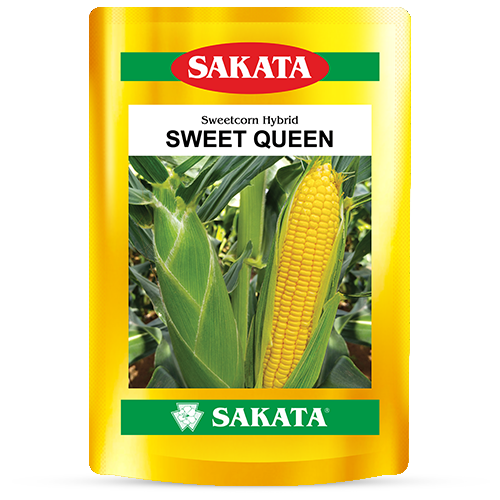
F1 Sweet Queen 0174

Crop Name Sweet Corn
Hybrid Name F1 Sweet Queen 0174
Segment Tropical
Plant Habit Strong vigorous growth
Maturity Period 75–80 DAS
Characteristics • Good ear tip filling and kernel row arrangement
• Attractive bright yellow colour of kernels
• 14–15% Brix value with excellent taste
• Suitable for processing and fresh purpose
Average Cob Weight 600–700 g
Climate Warm, sunny conditions with an optimum temperature range of 16–29°C
Sowing Window All season
Focused Market All India
Parameter Description
Scientific name Zea mays convar. saccharata var. rugosa
Hybrid F1 Sweet Queen 0174
Soil Sweet corn thrives in well-drained soils with an optimal pH range of 6.5 to 7.5.
Land Preparation The main field should be ploughed 3-4 times to get a fine tilth. Farm yard manure @ 25-30 t/ha is incorporated during the last ploughing.
Spacing 45*30 cm
Climate Sweet corn thrives in warm, sunny conditions, typically needing temperatures between 16-29°C (60-84°F) for optimal growth.
Season Sweet corn grown in all seasons
Seed Rate 8-10 kg/ha
Fertilizers & Manures
Type Quantity Notes
FYM 20-25 t/ha
Nitrogen (N) 250 Kg/Ha 25 % basal dose, 50 % @ 25 DAS, 25 % @ 45 DAS
Phosphorus (P₂O₅) 75 Kg/Ha 100 % basal dose
Potassium (K₂O) 60 Kg/Ha 100 % basal dose
Any special cases: No
Irrigation Provide adequate irrigation, especially during critical growth stages like knee-high stage, flowering, and grain filling. Weekly twice irrigation needed
Weed Control Manual weeding at initial stages was needed
Any special crop practices
Diseases
Name of the diseases Symptoms & management
Northern Corn Leaf Blight NCLB disease attacks the foliage and can occasionally attack husk leaves covering sweet corn ears. Lesions appear on the lower leaves first and progress upward to the newly emerged leaves at the top of the sweet corn plant. Lesions are long (up to 6 inches) and generally cigar-shaped.
Spray: Tricyclazole 18% + Mancozeb 62% WP (1g/L), Metiram 55% + Pyraclostrobin 5% WG (2g/L)
Rust Common rust is most severe when plants are infected initially at early vegetative growth stages and leaves forming plant whorls become infected. By silking, both sides of sweet corn leaves may show oval, cinnamon-colored pustules (blister-like growth).
Spray: Mancozeb 75% WP (2g/L)
Stalk rot Wilting and drying of the plants and discoloration of internodes.
Control: COC @ 2 gm/ltr + K cyclin 0.2 gm/ltr, Propineb 70% WP @ 2 gm/ltr, Hexaconazole 5% EC @ 1.5 ml/ltr
Downy Mildew Downy mildew is caused by the fungus Pseudoperonospora cubensis. It is prevalent in areas of high humidity and disease is first seen as yellow angular spots on the upper surface of the leaves. Under conditions of high humidity, whitish powdery growth appears on the lower surface of the leaves. The disease spreads rapidly killing the plant quickly through rapid defoliation.
Control: Metalaxyl 4% + Mancozeb 64% (2 gm/L), Carbendazim 12% + Mancozeb 64% WP @ 2 gm/ltr, Dimethomorph 50% WP @ 1.5 gm/ltr
Pests
Name of the pests Symptoms & management
Corn Borer Larvae tunnel into stalks and ears, causing damage and making the corn less appealing.
Spray: Chlorantraniliprole 18.5% SC (0.3 ml/L), Emamectin Benzoate 5% SG (1g/L)
Corn Aphid Aphids suck sap from leaves, cob, reduce growth and encourage sooty mold.
Spray: Acetamaprid 20% SP (1g/L)
Harvesting Maturity: 75-80 DAS
Yield 30-35 t/ha


No description