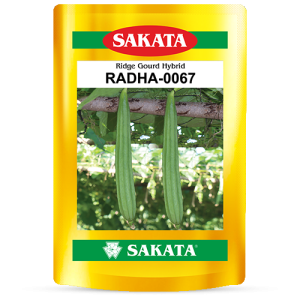
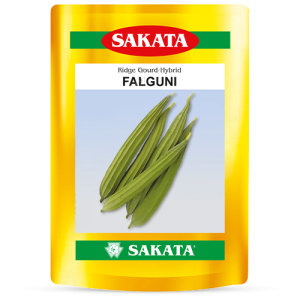
| Scientific name |
Luffa acutangula L |
| Hybrid |
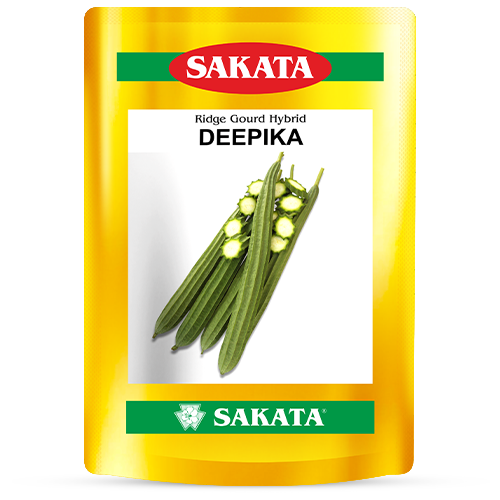
F1 Deepika 8302 |
| Soil |
Sandy to sandy loam and medium black soils rich in organic matter with pH range of 6.5- 7.5 is considered as optimum |
| Land Preparation |
The land is ploughed and brought to a fine tilth by 1-2 crosswise ploughing and levelled. Furrows are opened at a distance of 1.5-2.5 m depending on the support system to be adopted. |
| Spacing |
150*60cm |
| Climate |
It is a warm season crop grown adopted to Temperature range of 24o- 27oC is considered as optimum for the growth of the vines. |
| Season |
Rainy: June- Sep
Winter: Oct-Dec |
| Seed Rate |
1.5 to 2.5 kg/Ha |
| Fertilizers & Manures |
| Type |
Quantity |
Notes |
| FYM |
25 ton/Ha |
|
| Nitrogen (N) |
200 Kg /Ha |
Half the N and entire P & K should be applied before planting. The balance N is given at the time of flowering. The fertilizer is applied in a ring at 6-7 cm from the base of the stem. |
| Phosphorus (P₂O₅) |
25 Kg /Ha |
| Potassium (K₂O) |
100 Kg /Ha |
| Any special cases : No |
|
|
| Irrigation |
Irrigation is given at weekly intervals to keep the moisture well maintained at the root zone, to promote rapid taproot development. |
| Weed Control |
The crop needs 2-3 weeding operations in order to keep if free from weeds. Normally the first weeding is done 30 days after planting. Subsequent weeding is done at a monthly interval. |
| Any special crop practices |
Ridge gourd being a weak climber needs support for its growth. The plants trailed on the support (bower) continues to give yield for 6-7 months.
In bower system, planting is done at a spacing of 2 x 1.5 m. Furrows are opened up at 2 m and irrigation channels are laid out at 5-6 m distance. Wooden poles (3 m in height) are pitched on both the ends of alternate furrows at a distance of 5 m. these poles are connected with wires.
The wires along the furrows are further connected with cross wires fastened at 45cm distance so as to form a network of wires. Seeds are dibbled at distance of 1 m along the furrow and covered lightly with soil. The vines take about 1.5-2 months to reach the bower height, hence the vines during the initial stages of growth are trailed on ropes till they reach the bower. Once the vines reach the bower height, the new tendrils are then trailed on the bower |
| Diseases |
| Name of the diseases |
Symptoms & management |
| Gummy Stem Blight |
It is fungal disease with soil borne nature produce water-soaked lesions on leaves and stems, which can turn brown or tan and eventually become cankers that exude a gummy substance
Control : Use disease free seeds, crop rotation , paste stem with COC 50% WP 3g/L, Chlorthalonil 75 % @ 2 gm /lt |
| Fusarium Wilt |
This disease characterized by wilting, yellowing, stunting, and eventually death of the plant
Control : Use resistant hybrids, , crop rotation, Drenching of Propiconazole 5% EC 2ml/L |
| Powdery Mildew |
This disease is favored by high humidity, white powdery residue primarily on the upper leaf surface. On the lower surface of the leaves circular patches or spots appear. Severely attacked leaves become brown and defoliation
Control : Carbendazim (1ml/litre of water) or Karathane (0.5 ml/litre of water) , tebuconazole 50 % + Trifloxystrobin 25 % @ 0.5 gm / ltr or Meptyl dinocap @ 0.5 gm /ltr |
| Downy Mildew |
Downy mildew is caused by the fungus Pseudoperonospora cubensis. It is prevalent in areas of high humidity and disease is first seen as yellow angular spots on the upper surface of the leaves. Under conditions of high humidity, whitish powdery growth appears on the lower surface of the leaves. The disease spreads rapidly killing the plant quickly through rapid defoliation
Control : Metalaxyl 4% + Mancozeb 64 % (2 gm/L), Carbendazim 12 % + Mancozeb 64 % WP @ 2 gm / ltr, |
| Mosaic |
This virus disease produce small irregular yellowish patches are seen on the leaves. Some leaves show vein clearing in one or two lobes of the leaf and severely infected plants show reduction in leaf size and elongation and/or suppression of one or two lobes. Young developing leaves are completely distorted and malformed with considerable reduction in their size. Some of the leaves show marked reduction in the development of lamina resulting in a shoe- string effect. The virus is transmitted by by aphids.
Control : Acepahte 20% SP (1g/L) |
|
| Pests |
| Name of the pests |
Symptoms & management |
| Aphids and White flies |
Colonies of nymphs and adults attack leaves and tender shoots and suck the sap; Leaves curl and dry up.
Control : Acepahte 75 % SP (1.5 g/L), Dimethioate 1.5ml/L, Imidacloprid 30.5 % SC @ 0.25 ml / ltr, Diafenthiuron 50 % WP @ 1 gm /ltr, 30-35 blue sticky traps / Ha |
| Leaf Cutter |
It will damage the leaves by feeding on it.
Control Measures: Chloro ( Organophosphate) 20 EC @ 2 ml /ltr |
| Fruit Borer |
Adult moth lays eggs inside the fruit by piercing and after hatching the larva will feed on the flesh and cause fruit damage.
Control Measures:
Clean cultivation, i.e. removal and destruction of fallen & infested fruits daily.
Deep ploughing to expose hibernating stages
Application of spray baits.
30-35 yellow sticky traps /Ha |
| Fruit fly |
Attack fruits. Reddish dark brown flies with hyaline wings, lay eggs under the skin of the fruits; Maggots feed on the pulp of fruits. Infested fruits start rotting and rendered them unfit for human consumption; Fruits show dark-brown, rotten, circular patches and fall off prematurely
Control Measures:
Clean cultivation, i.e. removal and destruction of fallen & infested fruits daily.
Deep ploughing to expose hibernating stages
Application of spray baits.
30-35 pheromone traps /Ha |
|
| Harvesting |
Crop is ready for harvest in about 40-45 days after sowing. Over-mature fruits will be fibrous and are unfit for consumption. To avoid over-maturity, picking is done at 3-4 days interval. Harvested fruits are packed in baskets to avoid injury and can be kept for 3-4 days in a cool atmosphere. |
| Yield |
45-50 t/ha |