| Scientific Name |
Abelmoschus esculentus L. |
| Hybrid |
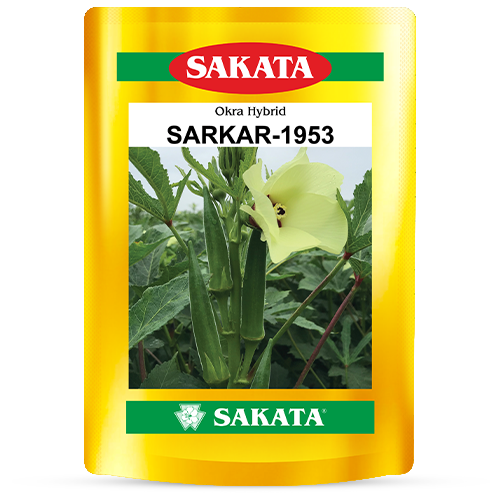
F1 Sarkar 1943 |
| Soil |
Okra prefers loose, well drained and rich soil. The ideal pH for growth of plants is 6-8. |
| Land Preparation |
Field is ploughed thoroughly for 2-3 times for making soil to a fine tilth. Ridges and furrows or raised beds are prepared and dibbling on sides of ridges or on raised beds sows seeds. Soak seeds for 6-12 hours before sowing to enhance germination during summer. |
| Spacing |
60 × 30 cm |
| Climate |
Bhendi is a typical tropical or sub-tropical crop and cannot tolerate frost. Performance is also adversely affected by drought, low night temperature and shade Under high temperature and low humidity, plant growth is stunted and will be shorter in stature. Similarly flowers drop when day temperature exceeds 42°C. |
| Season |
All seasons |
| Seed Rate |
6-7 kg/ha |
| Fertilizers & Manures |
| Type |
Quantity / Notes |
| FYM |
20-25 t/ha |
| Nitrogen (N) |
200 Kg/Ha |
| Phosphorus (P₂O₅) |
100 Kg/Ha |
| Potassium (K₂O) |
100 Kg/Ha |
| Any special cases: No |
|
| Irrigation |
Water stress at flowering and fruiting stages will drastically influence growth of plants, size of fruits and yield. Immediately after sowing, field is irrigated. Subsequent irrigation is given at fixed intervals depending on texture of soil and climate. In black soils, irrigation is done at 5-6 days interval. |
| Weed Control |
Manual weeding was employed to remove weeds |
| Any Special Crop Practices |
|
| Diseases |
| Name of the Disease |
Symptoms & Management |
| Powdery Mildew |
This disease is favored by high humidity, white powdery residue primarily on the upper leaf surface. On the lower surface of the leaves circular patches or spots appear. Severely attacked leaves become brown and defoliation
Control: Carbendazim (1ml/litre of water) or Karathane (0.5 ml/litre of water), Tebuconazole 50 % + Trifloxystrobin 25 % @ 0.5 gm/ltr or Meptyl dinocap @ 0.5 gm/ltr |
| Yellow Vein Mosaic Virus (YVMV) |
Causes yellowing of veins, leaf thickening, and stunted growth
Spray: 1.5ml/L dimethoate, Acetamiprid 20% WP @ 1 gm/ltr, Diafenthiuron 47% + Bifenthrin 9.4 % SC @ 1 gm/ltr |
| Blossom Blight |
Caused by Choanephora cucurbitarum, this fungal disease affects blossoms and young pods, causing them to fail to develop.
Spray: Spraying with bavistin 0.1% 5-6 times at fortnightly intervals effectively controls the leaf spot. |
| Enation Leaf Curl Virus |
Causes leaf distortion and thickening
Spray: 1.5ml/L dimethoate, Acetamiprid 20% WP @ 1 gm/ltr, Diafenthiuron 47% + Bifenthrin 9.4 % SC @ 1 gm/ltr |
| Rhizoctonia Wilt |
This fungus causes wilting by blocking the xylem and phloem of the roots there by stopping the supply of nutrients and water to the plant
Control: Soil drenching with Fosetyl AL 80 % WP @ 1 gm /ltr + Carbendazium 50 % WP @ 2 gm/ltr. Chlorthalonil 50 % WP @ 2 gm /ltr, Metalayxl 8 % WP + Mancozeb 64 % WP – 2 gm /ltr |
| Fusarium Wilt |
This fungus causes wilting by blocking the xylem and phloem of the roots there by stopping the supply of nutrients and water to the plant
Control: Soil drenching with Aliete @ 1gm /ltr + Carbendazium 50 % WP @ 2 gm/ltr. Chlorthalonil 50 % WP @ 2 gm /ltr, Metalayxl 8 % WP + Mancozeb 64 % WP – 2 gm /ltr |
|
| Pests |
| Name of the Pest |
Symptoms & Management |
| Shoot and Fruit Borer |
Terminal shoots wither and droop, Shedding of buds and flowers, Bore hole in fruits and deformed fruits
Control: Emamectin Benzoate 5% SG (0.5g/L), Chlorantraniliprole + Lambda-cyhalothrin @ 0.5 ml/ltr, Flubendamide + Thiacloprid @ 0.5 ml/ltr |
| Whitefly |
Chlorotic spots on the leaves which latter coalesce forming irregular yellowing of leaf tissue, Severe infestation results in premature defoliation, Development of sooty mold, Vector of yellow vein mosaic virus
Control: Quinalphos 25% EC (1ml/L), Acetamiprid 20% WP @ 1 gm/ltr, Diafenthiuron 47% + Bifenthrin 9.4 % SC @ 1 gm/ltr, Propargite 50 % EC @ 2 ml/ltr |
| Aphids |
Colonies of nymphs and adults attack leaves and tender shoots and suck the sap; Leaves curl and dry up.
Control: Acephate 75 % SP (1.5 g/L), Dimethoate 1.5ml/L, Imidacloprid 30.5 % SC @ 0.25 ml / ltr, Diafenthiuron 50 % WP @ 1 gm /ltr, 30-35 blue sticky traps / Ha |
| Red Cotton Bug |
Infested seeds become discoloured & shrivelled
Control: Phosphamidon 40 SL @ 600 ml/ha |
|
| Harvesting |
Maturity : 40-45 days. Harvest fruits when they attain maximum size but still tender. Harvesting is done in alternate days with a knife or by bending pedicel with a jerk. For harvesting, cotton cloth hand gloves should be used to protect fingers from stinging effect. It is advisable to harvest in morning hours since fruit hairs will be soft. Sprinkling water on pods during night will keep them cool and fresh for market. |
| Yield |
25-30 t/ha |