sakata Close

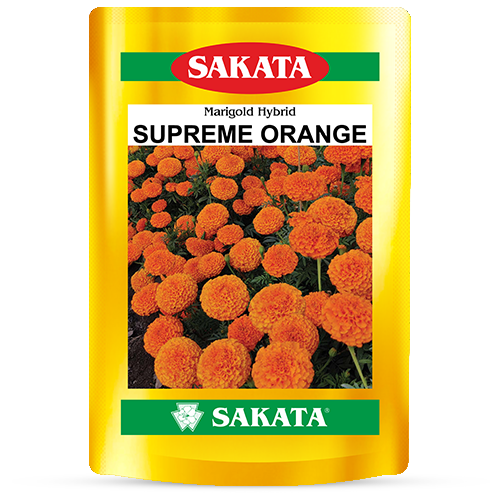
F1 SUPREME ORANGE

Crop Name Marigold
Hybrid Name F1 Supreme Orange
Segment Orange
Plant Habit Semi-tall plant with good branching (2–3 feet plant height)
Maturity Period 40–45 DAT
Characteristics • Flower weight of 15–16 grams
• Compact, ball-shaped, and attractive deep orange flowers
• Highly accepted in the market with superior price realization
Average Yield 7–8 ton/Ha
Climate The optimum temperature range for its growth is 18–20°C.
Sowing Window All Season
Focused Market All India

Scientific Name Tagetes patula
Hybrid F1 Supreme Orange
Soil Well-drained loamy soil with a soil pH of 7–7.5 is considered ideal. Avoid marigold cultivation in acidic and alkaline soil.
Land Preparation Plough the field to a fine tilth and incorporate 10 tonnes of FYM per acre. Irrigate before sowing. Use seedlings for transplanting after 1 month of sowing or when they have 4–5 leaves.
Spacing 90 × 60 cm
Climate Optimum temperature: 18–20°C
Season
Season Type Sowing & Harvest Period
Winter Sowing: September; Transplanting: October; Harvesting: January
Summer Sowing: January–February; Transplanting: February–March; Harvesting: May–July
Rainy Sowing: June; Transplanting: July; Harvesting: September
Seed Rate 0.75 kg/ha
Fertilizers & Manures
FYM 20–25 t/ha
Nitrogen (N) 90 Kg/Ha 45 Kg as basal dose and 45 Kg top dressing
Phosphorus (P₂O₅) 90 Kg/Ha Basal application
Potassium (K₂O) 75 Kg/Ha Basal application
Any special cases: No
Irrigation Field must be irrigated immediately after sowing. Number of irrigations & interval depends on type of soils, age of crop and climatic conditions Light soils : 5-6 days interval & Heavy soils : 8-9 days interval
Weed Control 4–6 manual weedings
Any Special Crop Practices Pinching: It involves the removal of apical buds which stimulates lateral branching and results in a more bushy and compact plant with more flowers. It delays flowering but results in the production of more flowers. Pinching is recommended to be done after 25-30 days after transplanting.
Diseases
Damping Off Most prevalent during the seedling stage. Necrotic rings or spots appear on the young seedlings. In severe cases, the affected seedlings may collapse and die before they even emerge from the soil.
Controlled by drenching: Matalaxyl 4% + Mancozeb 64% WP (3g/L)
Collar Rot Fungus affects the collar region of the plant leading to discoloration of the stem disrupting xylem and phloem resulting in wilting of the plants
Control: Penflufen 13.28% + Trifloxystrobin 13.28% FS @ 0.5 ml/ltr, Pyraclostrobin 3.5% + Thiram 15% + Clothianidin 22.5% FS @ 0.5 ml/ltr
Powdery Mildew This disease is favored by high humidity, white powdery residue primarily on the upper leaf surface. On the lower surface of the leaves circular patches or spots appear. Severely attacked leaves become brown and defoliation
Control: Carbendazim (1ml/litre of water) or Karathane (0.5 ml/litre of water) , tebuconazole 50 % + Trifloxystrobin 25 % @ 0.5 gm / ltr or Meptyl dinocap @ 0.5 gm /ltr
Leaf Spot & Blight Causes dark, circular lesions with concentric rings on leaves.
Control: Carbendizim 12% + Mancozeb 3% WP (2g.L)
Botrytis Blight / Gray Mold Flowers may appear water soaked and turn brown or grey as the disease progresses. Gray fuzzy mold growth appears on flowers and foliage. Stems may rot leading to the collapse of plants.
Spray: Chlorothalonil 75% WP (2g/L), Spary Copper Oxy Chloride 50% WP (2g/L)+ Streptomycin 90% + Tetracycline hypochloride 10% (0.5g/L), Kasugamycin 5 % + COC 45 % WP @ 2 gm /ltr
Pests
Leaf Miners The miner scrap the chlorophyll content forming a serpentine markings on the leaves
Control: Cyantraliprole 10.26 % OD @ 1.8 ml/ltr, Chlorantraniliprole 8.8 % + Thiamethoxam 17.5 % @ 0.5 gm/ltr
Thrips Cause damage to leaves and fruits, and vector Tomato Spotted Wilt Virus (TSWV). Use blue sticky traps and spray Fipronil 7% + Hexythiazox 2%SC, Spirotetramat 240g/L
Aphids & Whiteflies Colonies of nymphs and adults attack leaves and tender shoots and suck the sap; Leaves curl and dry up.
Control: Acepahte 75 % SP (1.5 g/L), Dimethioate 1.5ml/L, Imidacloprid 30.5 % SC @ 0.25 ml / ltr, Diafenthiuron 50 % WP @ 1 gm /ltr, 30-35 blue sticky traps / Ha
Flower Borer & Leaf Cutter Damage the flower petals by feeding the petals and flower get damaged and it become non marketable
Control: Cyclaniliprole 10% DC @ 0.8 ml/ltr, Chlorantraniliprole 4.5 % + Novaluron 11.5% + Emamectin Benzoate 1.5% SE @ 1ml/ltr
Mealy Bug White, cotton-like masses on young shoots, stems, and leaves. The presence of a sticky substance called honeydew causes sooty mold development. Crinkled leaves. This leads to retarded growth of apical parts of shoots.
Spray: Thiomethoxam 25% WG0.5g/L
Harvesting Maturity 42–45 days
Yield 7–8 t/ha

No description